Adam Torres
Hey, I’d like to welcome you to another episode of Mission Matters. My name is Adam Torres, and if you’d like to apply to be a guest on the show, just head on over to MissionMatters.com and click on “Be Our Guest” to apply.
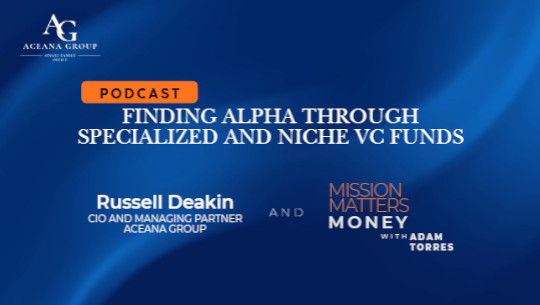
Today I have Russell Deakin on the line. He is Founding Managing Partner and CIO at Aceana Group, and this episode is part of our SuperReturn Berlin series, where we bring you the best of those who attended and participated in SuperReturn, which recently took place in Berlin.
Russell, welcome to the show.
Russell Deakin
Very nice to be here, Adam.
Adam Torres
Russell, I’m excited to get into today’s topic: finding alpha with niche VC funds. I’m also excited to learn more about Aceana Group and what you’re doing there as Founding Managing Partner.
But before we do that, let’s talk about SuperReturn Berlin. Give me some of the backstory. Have you been in the past? Is this your first time? What brings you out?
Russell Deakin
I’m going to date myself a little bit, but that’s okay.
Adam Torres
It does happen. I like that. Go ahead.
Russell Deakin
I remember SuperReturn Berlin when it wasn’t in Berlin — when it was actually in Frankfurt and, believe it or not, in Munich.
So it has been on my calendar for over 20 years. I hate to say it, maybe approaching 25.
Adam Torres
I don’t hate to say it, Russell. You have the record now.
I’ve been going for records here, and I think the previous record was maybe 12 to 15 years. I know nobody approached 20.
So congratulations. Your prize is… I don’t really have one, but we’re going to reach out to the organizers.
Russell Deakin
That’s amazing.
It’s definitely one of the highlights of the calendar year.
You’ve got to put a lot of time into it to prepare. Frankly, even though I’ve been doing it for so many years, I still get my team to start preparing eight to ten weeks out because it’s just so busy.
If you don’t put in the time to get organized beforehand, it becomes too much of a zoo.
For those who prepare properly, it can be very enjoyable and productive, which it was this year.
Adam Torres
Because you’ve been going for so long, I’m curious: how have you seen it evolve?
I haven’t been able to ask this question of others yet, but at a high level, how has it evolved for you?
And I guess it’s a two-part question: how has it evolved, and why do you stay so loyal to going every year? Obviously, there are a lot of different ways you could be spending your time.
Russell Deakin
Certainly.
One of the things I think it does — and it’s funny because even for those fundraising, and in our case where we are investing in funds — is make what is still a pretty inefficient system more efficient.
To be able to have, in one location, GPs from Asia, Europe, the United States, and even other places like South America and, to a lesser extent, Africa, is an efficient way, if you organize yourself, to meet a lot of managers from around the world in a very short period of time.
Perhaps just as importantly, if not more importantly, I spend probably 40% of my time talking to fellow LPs and discussing other funds they’ve met and their insights.
I’m happy to share, and they share with me.
I probably spend 25% of my time talking to GPs. People might say that’s a little less, but that’s good because I also leave the other part of the time for serendipity.
There’s a lot of serendipity that goes on.
It’s the most social of all the SuperReturn events and, frankly, one of the most social large industry-wide conferences that I go to. It’s worthwhile to have that serendipity and attend the social events.
So it’s quite the marathon, from 7:30 a.m. until at least midnight.
When I leave after four days, I’m pretty tired.
Adam Torres
Then it’s SuperSleep.
No, I’m just playing.
Russell Deakin
Yes. On the way back home, we definitely sleep well on the plane.
Adam Torres
Amazing.
Let’s switch it up a bit here. Maybe give us an overview of Aceana Group and what you’re doing at the firm.
Russell Deakin
Sure.
I founded Aceana Group in 2006.
Before that, I was actually a partner in Latin America at Brazil’s oldest venture capital and private equity firm.
When I emigrated to the U.S. for the third time in 2006, we moved to Miami, and I was raising a fund for a venture capital and private equity firm called CRP.
At the same time, I started thinking, “What am I going to do? I need to diversify.”
I started investing off my own balance sheet, and then from 2011, I started doing it full time.
We have a team of six people. Two go between India and Turkey, one is in Brazil, I’m in Miami, and two are in Palo Alto.
We invest internationally as well as in the U.S. across private markets, mostly venture and growth capital.
We’ll also do co-investments with successful portfolio companies of our fund managers.
When their portfolio companies raise another round and the venture firm goes in, we’ll consider going in as well. We’ve continued to expand on that.
Today, our portfolio is probably around 20 funds that we’ve invested in, along with probably 50 to 60 co-investments.
It’s something I really enjoy, and there are always new things.
We’ll talk a little bit more about how that has evolved over the years, but that’s my background and what I continue to enjoy doing — and hopefully will do for many more years.
Adam Torres
Amazing.
What do you enjoy about — and I want to use the right word here — “hunting”?
Maybe not hunting. Finding is probably a better word.
What do you enjoy about finding new funds, finding new fund managers, and going through that sifting process of figuring out what’s next?
Russell Deakin
I’d say one thing is intellectual curiosity, especially when it comes to venture and growth capital.
It gives you an eye on the future.
I was actually speaking to a gentleman from a very successful, large billionaire family office that did a lot of investments in hedge funds and public markets.
I said, “Really?”
He said, “Well, one exception we have is that we also do venture capital because that is an eye on the future versus an eye on what’s going on.”
I think it’s the intellectual curiosity that I enjoy.
I’ve lived on three continents, so I think I’m fairly good at connecting dots, seeing trends, and then taking those ideas to other places.
I enjoy different cultures. I was a foreigner in a couple of countries growing up, and I think it makes life much more interesting.
We’re lucky to be in an industry where there are a lot of bright people and a lot of bright ideas.
I often come away feeling very optimistic about the future, although obviously we have some very serious issues going on in the world.
I think I’m always, let’s say, realistically optimistic.
A lot of that comes from finding good fund managers and, even more importantly, good people.
That’s what we find when we go out, talk to, and meet a lot of managers.
There are many, many managers who are very good.
I apologize that I’m not investing in all of them. I can’t invest in all the good ones, but fortunately, we have invested in some good ones as well.
Adam Torres
You’ve hinted at it, but maybe let’s go a little further into how your investment strategy has evolved and where it is today.
Russell Deakin
2001 was the first time I invested off my own balance sheet.
Back then, I was a venture capital partner in Brazil and obviously had exposure in Brazil, which was fine.
But I thought, if I’m going to do something else, I need to diversify. I’ve always thought in dollars, and I wanted to start investing.
It was actually in Silicon Valley.
We did a fund-to-fund strategy for co-investments in top Silicon Valley GPs.
I think that was the right way to go because the diversification stopped me from making the mistake of concentrating on only one fund manager.
If that one manager didn’t do well, obviously, if you don’t start well, you don’t finish well.
Warren Buffett started well, and that’s why he’s known.
Fortunately, I started well. My first investment gave me a 3x net return.
Then I was in, and I started going more into funds.
As I matured, the strategy went from general funds to what I do now.
I like funds that have deep technical vertical expertise and often 15 or 20 years of experience in that vertical.
It doesn’t mean I don’t want to do first-time funds, but I won’t do first-time investors.
There’s a big difference.
We’ve also moved somewhat because of valuations.
We no longer really invest in large funds and large buyouts.
I think there’s a space for that, and we still even have in our portfolio a fund-of-funds containing some of the largest buyout funds.
That’s what I would call leveraged beta.
Adam Torres
When you say “large,” what size are you talking about?
Russell Deakin
We actually found a group that was very interesting.
They did a fund that invested, in terms of AUM, in the largest private equity buyout funds.
Think of Carlyle. Think of KKR.
Five billion dollars is probably the smallest fund within that category. You’re talking about $5 billion, $15 billion, $20 billion.
On that basis, I consider it leveraged beta.
Over the last 40 years, if you look at it, you’re talking about roughly 14% to 17% net and around 400 basis points over the S&P.
That’s fine. It’s a nice building block in a portfolio.
But every family office is different.
As a family, we still have an operating business in Brazil, a real estate developer. We also own a productive farm with rice and cattle that provides us with cash flow.
Given my experience as a partner in a venture capital firm, I’m more alpha-seeking.
It’s almost a bifurcated model, and I can afford to do that.
On that basis, we’ve moved toward smaller funds over time.
Even some of the definitions within venture have changed.
I don’t believe a venture fund should be a billion dollars. To me, that’s not really a venture fund.
I think the sweet spot is more around $100 million to $300 million.
Now those are considered niche funds. That’s the way funds used to be.
The smallest venture funds in Silicon Valley used to be, believe it or not, $10 million way back when.
Adam Torres
Wow.
Russell Deakin
I think there is much more alignment between the GP and LP when the funds are smaller.
That’s my own personal opinion. There are examples of very successful large funds as well.
But for us, given what we like to invest in, we’re looking for alpha and underwriting toward 4x and 5x returns as some of our targets.
We think niche funds — which I would define as funds of around $50 million to $200 million — focused on very specific technical vertical expertise can be particularly interesting.
That might be deep tech, for example, which has been one of my most successful areas.
It could be an AI fund focused on healthcare, an AI fund focused on manufacturing, or a biotech fund.
We’ve also looked in the past at a fund focused on the intersection of later-stage life sciences and late-stage venture.
There are nuances around all of these.
But these are funds where the managers are really focused and taking advantage of the 10 or 15 years of experience they have in investing.
They can, I think, operate effectively with smaller funds.
If you’re investing at the earlier seed and Series A stages, obviously there’s more risk, but there’s also more upside.
We’re comfortable with that.
That’s how our strategy has evolved over time.
We’ve gone into smaller funds, and we’ve gone toward more funds with vertical expertise rather than generalists.
Fortunately for us, so far, that has worked out well over the last five or ten years.
Adam Torres
Considering that you’re seeking out and finding these niche VC funds — you mentioned deep tech — maybe we can go a little further.
You don’t have to name any specific funds if you don’t care to, but whether it’s a particular sector or something else, what excites you right now in the market?
What are you looking closely at?
Russell Deakin
At the end of the interview, I’m happy to provide my LinkedIn details and other information so people can reach out to me.
I’m happy to provide more details on a one-to-one basis.
I don’t think it’s appropriate for me to solicit or tell people particular names in a public forum, but I’m happy to discuss them in individual conversations.
So, what are we doing at the moment?
I’ll give you an example.
We just signed a new VC investment.
We do quite a lot in Silicon Valley, but not only in Silicon Valley. This one happens to be in Silicon Valley.
You’re always looking for a competitive advantage or a niche.
Sometimes the industry focus — such as being a deep-tech fund — is what’s important.
I think that is going to become more prevalent.
“Deep tech” is an overused word, but I’ll give you an example of something we found.
We just signed a term sheet this week on a fund.
This is my second deep-tech fund.
Their focus and the trends themselves might be relatively easy to identify, but they’ve done something I think is very unusual.
Because of the founder of the fund, who went to Stanford and Berkeley, they have extremely strong contacts and an operational focus that allows them to meet entrepreneurs while they are still at university.
Berkeley and Stanford are two tremendously important universities for startups, and he has very strong connections with entrepreneurs there.
That gives him an advantage that very few people have.
Adam Torres
That’s so interesting to me.
When you say it, it makes perfect sense.
You’re thinking, “That’s an inside edge,” right?
Russell Deakin
That’s an inside edge.
In the end, as I get a bit older, the numbers and the track record are obviously important, but I invest in people.
I’m fairly experienced and fairly intelligent, but I like to be the dumbest guy in the room with the least experience in the vertical.
That’s why I pay the management fees.
If I can find someone who has that edge and that nuance, it can sometimes come from technical expertise, sometimes from access, and sometimes from different strategies.
It’s not necessarily one unique thing.
But that type of edge or inside ability can make a difference.
In this case, it might be the alumni connections.
Another one we’re looking at is similarly linked with the alumni of Georgia Tech, for example, with very strong incubator connections.
It seems that if you get into these networks and connect with successful people earlier, then you have the ability to create access.
Let’s be honest: with a lot of venture capital and growth funds — particularly the smaller funds where we tend to play — access is an issue.
The smallest fund we might look at could be around $50 million and the largest around $1 billion, but let’s say our sweet spot is around $100 million to $300 million.
Access becomes an issue because the funds are small, and when they are very good, a lot of people want to get into them.
Even as a GP, you also need access to good people.
It’s about getting access to people, evaluating people, and working with people.
A GP needs access to founders, and I, as an LP, need access to the GPs.
People have become much more important in how I evaluate investments.
When I look at mistakes I’ve made, they generally weren’t because of the analytics or the objective data.
They came from not evaluating the people well enough.
If a GP is a very difficult person, the founders of the portfolio companies will not follow that person into the fire. That’s not good.
If founders are very difficult people, they won’t necessarily listen to good information.
It’s not simply about intelligence. It’s not simply about persistence.
These nuances are softer reads.
Perhaps I can credit some of that to my wife because she has a PhD in psychology, and I’ve picked up a few things through all these years of marriage.
Adam Torres
I love it. That’s amazing.
Russell, this has been great.
It’s been wonderful having you on the show today and learning more about your work.
It’s also been a great addition to the SuperReturn Berlin series that we’re creating, so thank you for coming on.
You mentioned earlier that if somebody wants to contact you, maybe through LinkedIn or your website, they can do that.
What’s the best way for people to connect with you?
Russell Deakin
Probably the best way is through LinkedIn, but people can also look at my website.
It’s www.aceanagroup.com.
Between one of those two, feel free to reach out to me, and we can respond.
As I said, I’m happy to share more.
We do a lot of Zoom calls with fellow investors. I exchange ideas and get access to new funds.
I enjoy helping, and I enjoy sharing, so I’m happy to do that as well.
Adam Torres
Amazing.
And for everybody listening, just so you know, we’ll definitely put some links in the show notes so you can connect with Russell on LinkedIn and also check out the website.
Speaking of the audience, if this is your first time with Mission Matters and you haven’t done it yet, hit that subscribe or follow button.
This is a daily show. You heard me correctly — each and every day, we’re bringing you new content, new ideas, and hopefully new inspiration to help you along the way in your journey as well.
So hit that subscribe or follow button.
Russell, thanks for coming on the show. I greatly enjoyed it.
Russell Deakin
Thank you very much, Adam.
Aceana Group, Insights