

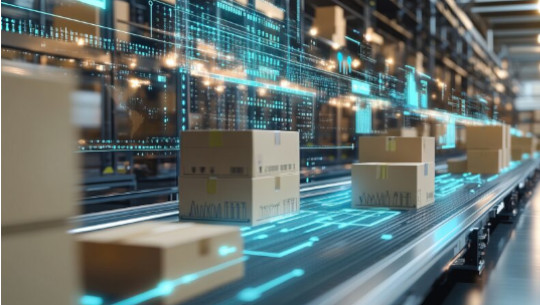
For much of the past two decades, supply-chain technology was primarily built to improve visibility. Companies digitized freight documentation, adopted warehouse and transportation-management systems, and invested in tools that made inventory and shipment movements easier to track. That work created an important foundation, but the next phase is less about simply knowing where goods are and more about how quickly businesses can respond when conditions change.
This shift is becoming increasingly important as supply chains contend with geopolitical disruption, changing trade patterns, labour constraints and more demanding fulfilment expectations. In that environment, visibility on its own has limited value. A delayed shipment becomes significantly more useful information when it can influence production schedules, warehouse staffing, customer communication, inventory allocation or alternative sourcing decisions. The direction of travel is therefore toward more connected operating systems, where transportation, warehousing, suppliers, inventory and physical infrastructure can respond to one another rather than function as isolated parts of the network.
That evolution is also changing how companies think about resilience. The immediate response to disruption is often associated with holding more inventory or relocating production closer to end markets, but the economics are more nuanced. The OECD’s 2025 Supply Chain Resilience Review suggested that large-scale relocalisation could reduce global trade materially without necessarily reducing volatility. The implication is that resilient supply chains are unlikely to become purely domestic; they are more likely to become more diversified, flexible and better connected across suppliers, transport routes and regions.
In practical terms, resilience is becoming a question of optionality. Businesses need to know not only what is happening across their network, but what alternatives are available when a supplier, route or facility is disrupted. That places greater importance on integrated data, digital customs processes, logistics infrastructure and systems capable of coordinating decisions across multiple parts of the supply chain.
The scale of the underlying physical network makes even modest improvements meaningful. In the United States, the freight system moved approximately 20 billion tons of goods valued at around $25 trillion in 2024. These flows depend on ports, highways, railways, airports, warehouses and pipelines, creating significant coordination requirements across complex logistics networks. The result is that logistics technology increasingly needs to operate across different modes of transport and stages of the supply chain, rather than within a single warehouse or transportation function.
This becomes particularly relevant as the industrial base expands. U.S. manufacturing construction remains well above pre-pandemic levels, reflecting continued investment in factories and production capacity. New facilities, however, create requirements far beyond the factory floor. They need inbound materials, storage, transportation capacity, inventory coordination and reliable distribution. As more capital is committed to physical infrastructure, improving the utilization of those assets becomes increasingly important. Technology is not the only driver of productivity, but better coordination can help companies generate more output from existing labour, equipment and facilities.
Automation is becoming one of the more visible expressions of this change. Warehouse and logistics robotics are moving beyond fixed industrial machinery toward mobile systems that can transport goods, support loading and operate across distribution environments. More than 100,000 transportation and logistics service robots were sold globally in 2024, according to International Federation of Robotics data cited in the source material. Yet the more significant development may be the evolution of the business model. Robotics-as-a-service can reduce the upfront cost of adoption for customers, making automation accessible to a broader range of operators while creating recurring revenue opportunities for providers. At the same time, it places greater importance on reliability, fleet utilization, maintenance and service economics.
These developments are taking place within a supply chain that remains fundamentally global. More than 80% of international merchandise trade by volume moves by sea, and recent geopolitical tensions, tariffs and rerouting have altered shipping patterns rather than brought global trade to a halt. The broader picture is one of reconfiguration. Production is becoming more distributed, trade routes are changing, and companies are building more flexibility into sourcing and manufacturing decisions.
This is evident across the major industrial regions. Asia remains central to global manufacturing and automation, while Europe combines sophisticated production networks with increasingly demanding regulatory and sustainability requirements. Across global markets, companies are investing in technology and infrastructure that can improve the coordination of increasingly complex production and distribution networks. A modern supply chain may therefore involve software developed in one market, components manufactured in another, final assembly in a third and distribution across several jurisdictions. The competitive advantage increasingly lies in coordinating those movements effectively rather than simply optimizing each facility in isolation.
Energy and resource efficiency are also becoming part of the same operating equation. Warehouses require power and cooling, refrigerated logistics depends on continuous energy management, and transportation networks remain exposed to fuel and emissions costs. Technologies that reduce empty freight miles, improve warehouse utilization or limit refrigeration losses can therefore create both economic and environmental benefits. This is significant because sustainability becomes more closely linked to operating efficiency rather than being treated as a separate corporate objective.
Taken together, these changes suggest that the next phase of supply-chain technology will be defined less by standalone tools and more by systems that become embedded in essential workflows. The strongest platforms are likely to be those that help businesses make better decisions across transportation, inventory, labour, facilities and sourcing, while demonstrating measurable improvements in throughput, service quality or asset utilization.
For emerging ventures in particular, the ability to solve a recurring operational problem, integrate deeply into customer workflows and demonstrate measurable economic value can improve the foundations for sustainable growth and long-term commercial success.
For investors and family offices, that creates an opportunity set that sits across software, industrial automation and infrastructure rather than within a single technology category. The sector still requires careful underwriting. Software businesses need durable customer relationships, meaningful integration and recurring revenue, while robotics and hardware-enabled models need to demonstrate reliable deployment, attractive utilization and manageable capital intensity. However, the long-term backdrop remains constructive. Global supply chains are becoming more complex rather than less important, industrial infrastructure continues to require better coordination, and technologies that become embedded in critical operating processes can develop durable positions within their customers’ businesses. For family offices with patient capital and the ability to invest across public and private markets, this creates an opportunity not only to participate in a long-duration structural theme, but also to support ventures whose success is increasingly tied to their ability to deliver tangible improvements in productivity, resilience and asset efficiency.
The most compelling businesses are therefore likely to be those that combine technological capability with clear operational relevance, giving them a stronger platform for sustainable growth and value creation over time.
Aceana Group, Insights